




From the characteristics of engineering methods such as channel excavation and retarding basins, to the practical preparation involved in hazard maps and evacuation planning — this article offers a comprehensive overview of flood disaster countermeasures. It also introduces the latest flood prediction solutions that leverage ensemble climate forecasting to assess inundation risk.
目次
- Introduction
- [Hard Measures] Overview and Examples of Flood Control Countermeasures
- [Soft Measures] Overview and Challenges of Flood Control Countermeasures by Phase
- Aqunia’s Unique Solutions
- Summary
1. Introduction
With the intensification of heavy rainfall driven by climate change, it has become a reality that levee improvements alone can no longer keep up. What is now required of local government officials is a shift toward the ‘watershed flood control’ approach promoted by MLIT, and a perspective on how to effectively combine various hard and soft measures.
This article provides a comprehensive and practice-oriented overview of key engineering methods, and explains the latest technologies for breaking through the limitations of existing flood prediction systems.
2. [Hard Measures] Overview and Examples of Flood Control Countermeasures
Hard measures refer to approaches that physically defend against and regulate flooding by developing civil engineering structures such as rivers and dams. Based on MLIT’s classification model, these are organized by function: ‘convey,’ ‘store,’ and ‘reduce.’
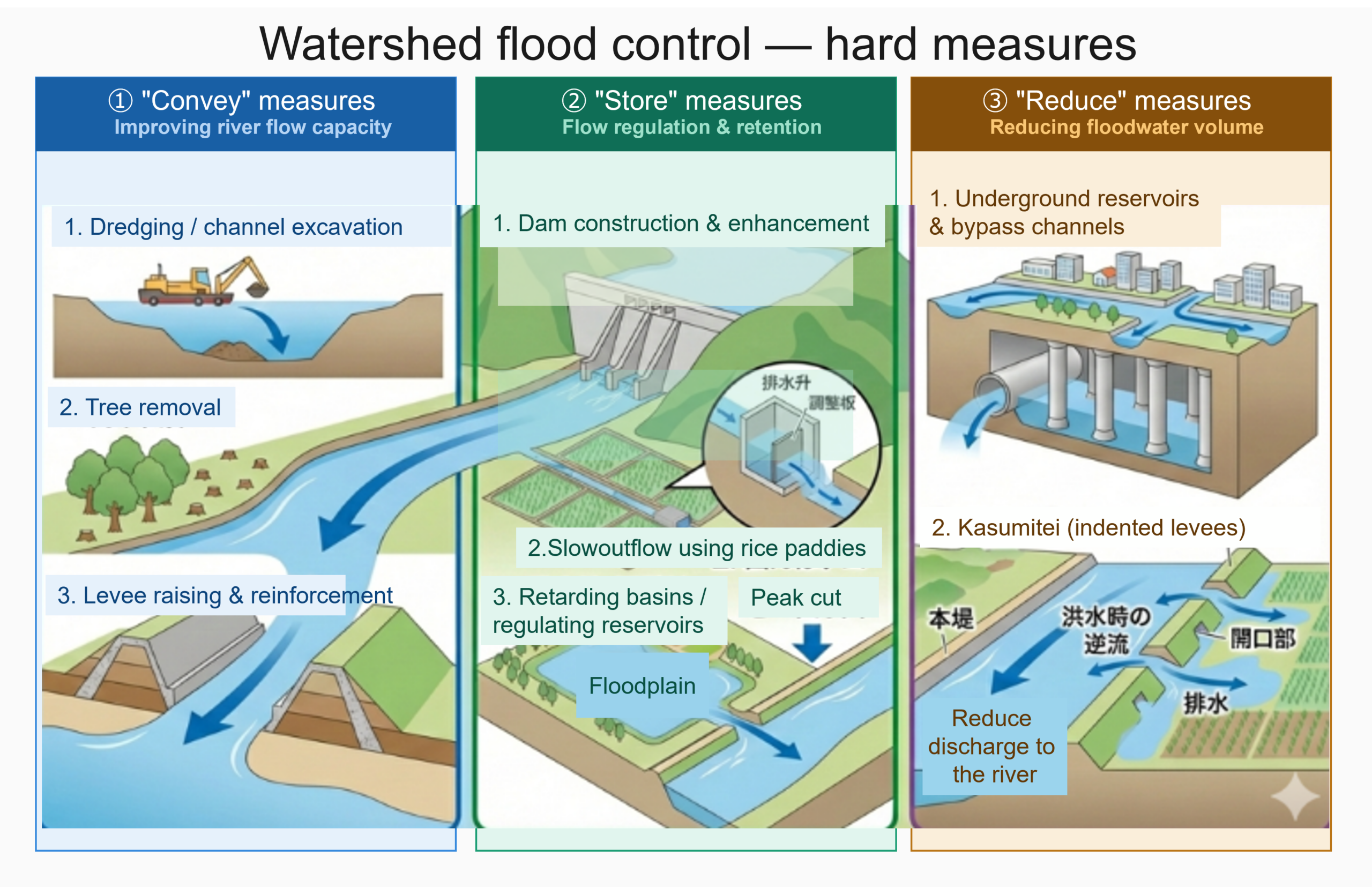
① ‘Convey’ Measures (Improving River Flow Capacity)
The most fundamental countermeasures — widening the river cross-section or removing obstacles so that floodwaters can flow smoothly to the sea.
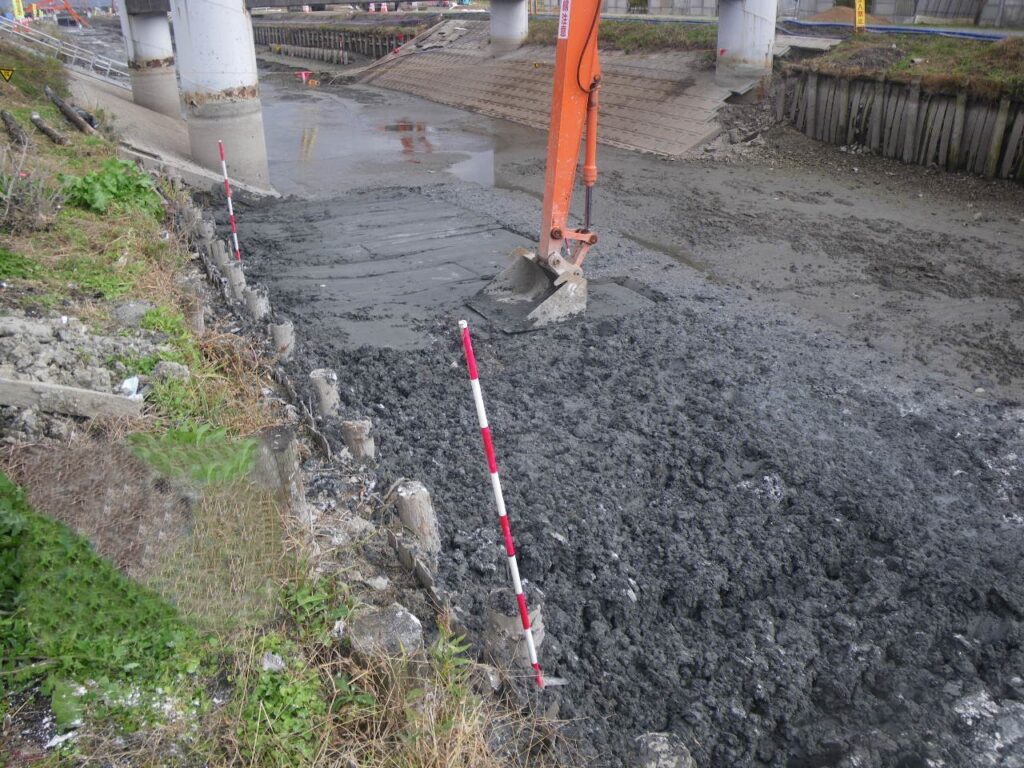
(1) Dredging and Channel Excavation
| Advantages | Immediate effectiveness: water level reduction achieved immediately after construction. Land acquisition advantage: tends to require relatively less new land acquisition. |
| Disadvantages | Spoil disposal: securing disposal sites and managing costs for large volumes of excavated soil. Saltwater intrusion: risk of saltwater damage from seawater migrating upstream at river mouths. |
| Example | Yamato River (Osaka/Nara) | Achieved approx. 0.3 m water level reduction alongside landslide countermeasures. 国土交通省「河川事業概要2024」 p63 |
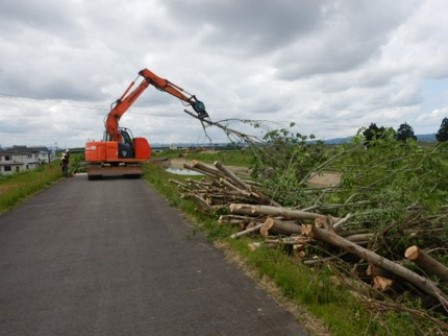
(2) Tree Removal
| Advantages | Cost-effectiveness: can be carried out more cheaply and quickly than large-scale civil engineering works. Prevention of secondary disasters: reduces risk of flood damage from fallen timber and bridge blockage. |
| Disadvantages | Ongoing maintenance: stumps re-sprout, incurring continuous management costs. Environmental considerations: areas may serve as wildlife habitats, requiring selective thinning. |
| Example | Uryu River (Hokkaido) | Estimated approx. 0.3 m upstream water level reduction from 700 m of clearing. Source:北海道開発局「雨竜川 出水の概要」P.5 |
#Low Cost #Maintenace #Countermeasure-of-tree
(3) Levee Raising and Reinforcement
| Advantages | Fundamental prevention of levee failure: the most reliable means of physically preventing flooding Securing evacuation lead time: extends time to levee failure, creating resident evacuation lead time. |
| Disadvantages | Enormous cost and duration: large-scale works result in massive project costs. Land acquisition: difficulties with land acquisition and home relocation negotiations for setback levees. |
| Example | Kitakami River (Iwate) | Built ‘zero evacuation failures’ foundation through elimination of unleveed sections. Source:岩手河川国道事務所「北上川水系河川整備計画」 |
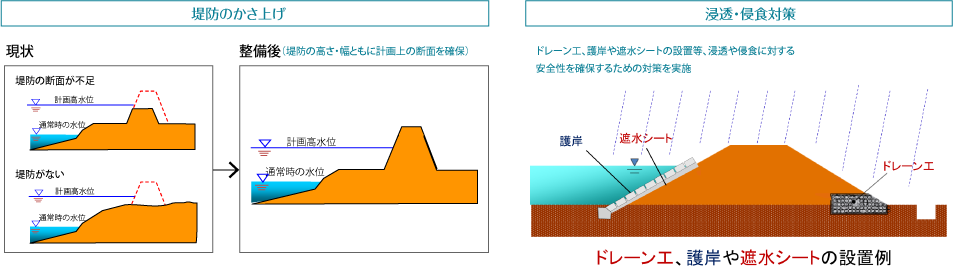
(Source: https://www.mlit.go.jp/river/mizubousaivision/hard.html)
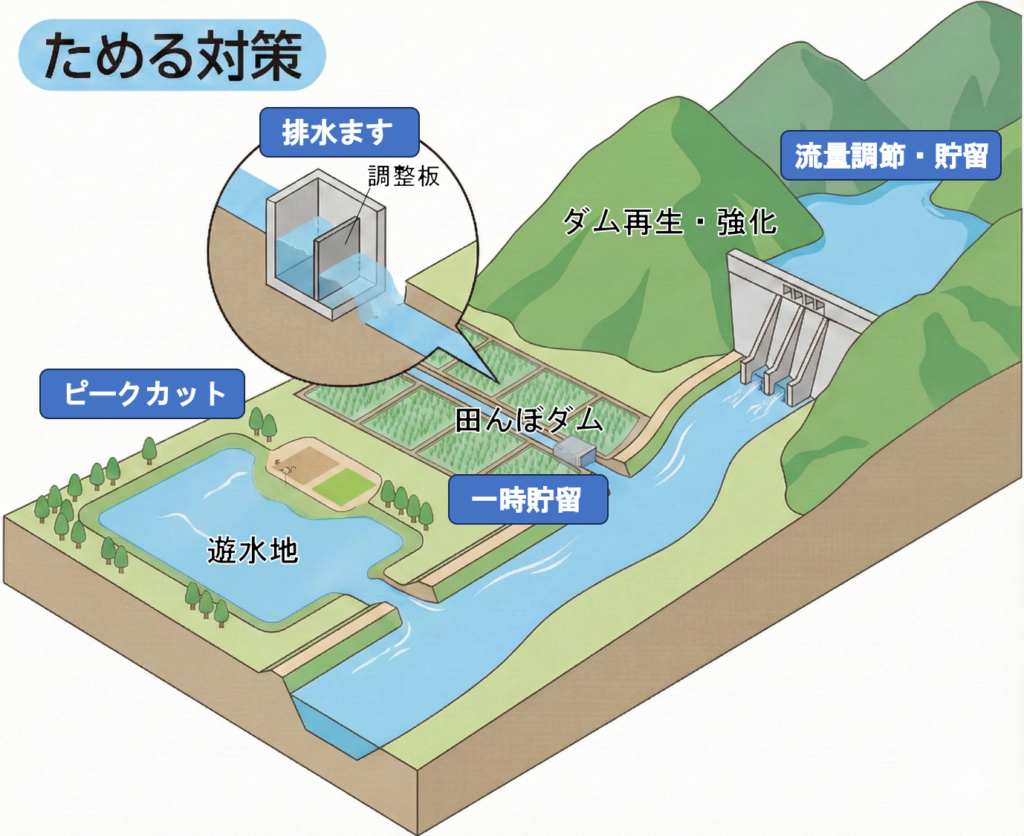
② ‘Store’ Measures (Flow Regulation and Retention)
Dams, retarding basins, and paddy field dams temporarily store rainwater to suppress peak discharge to downstream areas.
(1) Dam Construction and Enhancement
Beyond new construction, “dam revitalization” — which involves raising existing dams and adding discharge facilities — is attracting attention as a lower-environmental-impact countermeasure.
| Advantages | Reliable regulation capacity: a single facility can dramatically reduce water levels across the entire downstream area. Multi-purpose use: contributes to drinking water, agricultural water, and power generation as well as flood control. |
| Disadvantages | Long-term and high-cost: takes decades from planning to completion and requires enormous budgets. Environmental and social impact: major scale of village relocations and river ecosystem impacts. |
| Example | Tsuruta Dam Redevelopment (Kagoshima): capacity increased ~1.3x; estimated additional ~1.0 m downstream water level reduction. Source 国土交通省 九州地方整備局「鶴田ダム再開発事業の概要」 |
#Large-scale works #National/prefectural-led #Multi-purpose
(2) Retarding Basin and Regulating Reservoir Construction
Multi-purpose facilities that remain open as parks during normal times and serve as flood storage only when needed. An overflow weir is installed on land adjacent to the river to divert part of the floodwaters.
| Advantages | Reliable peak cut: extremely effective for localized water level reduction by diverting water at the moment river levels peak. Multi-purpose use: can be used as parks, sports facilities, or farmland during normal times. |
| Disadvantages | Large land requirements: securing storage capacity requires extensive flat land and consensus with landowners takes time Post-flood cleanup: ongoing maintenance costs arise from removing sediment and debris after flooding. |
| Example | Tsurumi River Multi-Purpose Retarding Basin (Kanagawa): 0.3 m water level reduction at peak. Source: 国土交通省 京浜河川事務所「川の市民情報」 |
#Medium-scale works #Community collaboration #Multi-purpose use
(3) Paddy Field Dams
Adjustment boards are installed in the drainage outlets of rice paddies to temporarily slow drainage during heavy rain, reducing the rate of outflow to downstream areas.
| Advantages | Low cost and immediate effect: inexpensive materials can be introduced quickly using existing rice paddies. Symbol of watershed flood control: when implemented broadly, water is stored in a distributed manner across the entire watershed. |
| Disadvantages | Coordination with farmers: understanding and cooperation of farmers regarding impacts and inundation risk is essential. Limits of individual effect: since individual storage capacity is small, area-wide uptake (participation rate) is key to success. |
| Example | Chagou River watershed (Niigata): 0.2 m reduction in peak discharge. Source 国土交通省 北陸地方整備局「田んぼダム効果量の試算について」 |
#Distributed countermeasures #Farmland utilization #Low-cost
③ ‘Reduce’ Measures (Reducing Floodwater)
Measures that prevent overflow by reducing the load on river channels through diversion and underground storage.
(1) Underground Diversion and Storage Measures (Bypass Channels / Underground Regulating Reservoirs)
In urban areas where channel widening is difficult, tunnels (bypass channels) and large-scale underground spaces (regulating reservoirs) are developed to bypass or temporarily store floodwaters
| Advantages | Effective land use: fundamental inundation countermeasures possible while minimizing urban land acquisition. Multi-layered defense: also functions as a receptor for sewer systems (inland flooding countermeasures). |
| Disadvantages | Enormous cost and construction period: massive project costs and long construction periods due to tunnel boring. Sophisticated maintenance: permanent costs for updating pump equipment and removing accumulated sediment and debris. |
| Example | Otsu Flood Bypass (Shiga), 公益社団法人リバーフロント研究所「大津放水路環境整備計画」 Kanda River/Kan-nana Underground Reservoir (Tokyo): approx. 540,000 m³ capacity dramatically reduced urban inundation. Source: 国土交通省 関東地方整備局「神田川・環状七号線地下調節池の効果」 |
#Underground space utilization #Bypass channels #Underground regulating reservoirs #Urban flood countermeasures
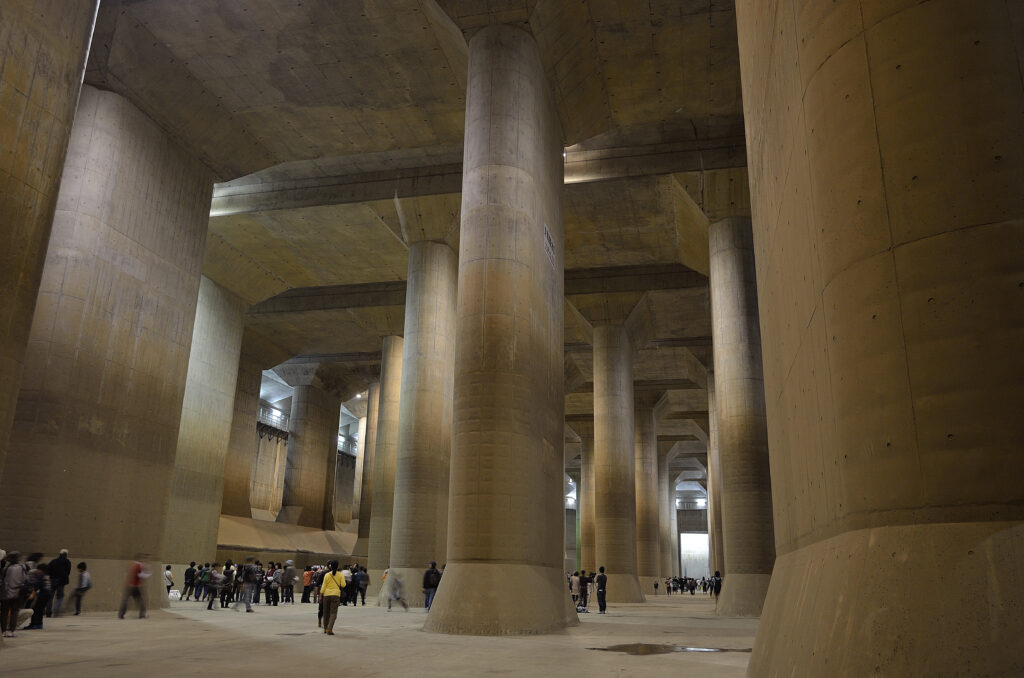
(Source:AMANO Jun-ichi https://web.archive.org/web/20161020120920/
http://www.panoramio.com/photo/62037005)
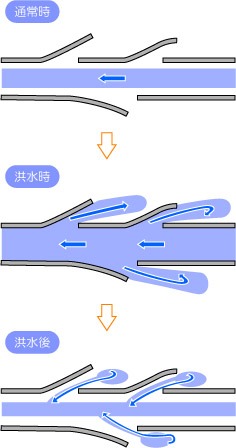
(2) Use of Kasumi-tei (Indented Levees)
A traditional levee construction method in which levees are laid in a staggered, non-continuous arrangement with openings (gaps) provided at intervals. Floodwaters are intentionally guided toward specific areas of land (farmland, etc.) to disperse energy.
| Advantages | Reduced risk of levee failure: water flows back through openings to relieve pressure on the main levee and prevent failure. Energy dissipation: gradual rather than sudden inundation suppresses the destructive force of flood flows. |
| Disadvantages | Accepting inundation: since specific areas are premised on being inundated, a high level of community consensus is essential Compatibility with modern land use: where former farmland has been urbanized, application is extremely difficult. |
| 実例 Example | Mogami River Basin (Yamagata): the ‘Kasumi-tei group’ dating from the Sengoku period continues to function as a core watershed flood control facility. 国土交通省 東北地方整備局 山形河川国道事務所「最上川電子大辞典」 |
#Traditional method #Energy dispersion #Accepting inundation
3. [Soft Measures] Overview and Challenges by Phase
Hard infrastructure (levees and dams) has its limits, and it is impossible to prevent all flood damage intensifying under climate change. Soft measures are indispensable to minimizing damage and enabling rapid recovery.
① Pre-disaster Preparedness / Disaster Prevention
Understanding the risks of where you live, and guiding people toward safer land
| Overview | Challenges |
| Risk visualization: developing multi-layered hazard maps showing not only 1-in-1,000-year events but also frequently occurring water levels (L1, L2, etc.). Reviewing living arrangements: guiding residents away from hazardous areas and mandating risk disclosure in real estate transactions. | The difficulty of communicating probabilities intuitively. Reaching consensus is difficult due to impacts on land and asset values. |
*L1:Design-scale rainfall (occurring once every 10 to 200 years), *L2: Assumed maximum-scale rainfall (once in 1,000 years)
#Multi-level risk information #Mandatory flood risk disclosure #Location optimization plan
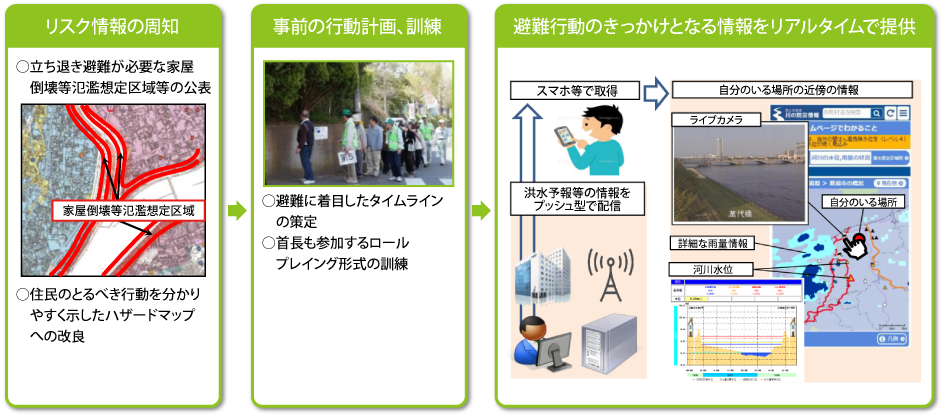
② Last-minute countermeasures
Eliminating information gaps and achieving ‘zero evacuation failures’
| Overview | Challenges |
| Timeline operations: promoting ‘My Timeline’ plans for individual residents alongside government action plans. Proactive information distribution: reliably delivering river water level data and live camera feeds to residents’ smartphones via social media. | Creating a social atmosphere that accepts evacuating even when nothing happens. How river administrators can technically support municipal mayors in issuing evacuation orders |
#My Timeline #Push-type information delivery #Hotline
③Post-Disaster (Recovery and Reconstruction)
Public-private collaboration to immediately rebuild the economy and livelihoods
| Overview / Example | Challenges |
| TEC-FORCE (Emergency Disaster Response Team): deploying drones and pump vehicles on a wide-area basis to immediately assess damage and begin drainage. Economic recovery support: promoting BCP development and ‘improvement-based recovery’ to achieve ‘build back better’ reconstruction. | Establishing support reception systems in preparation for functional breakdown of affected municipalities. Maintaining effectiveness of disaster agreements with local construction industries |
#TEC-FORCE #BCP #Build Back Better
4. Aqunia’s Unique Solutions
At Aqunia, we deploy solutions contributing to advance preparation and disaster response within the soft measures framework. Conventional approaches have tended toward either detailed modeling requiring enormous computation time, or fast but coarse-resolution methods. We are working on technology that achieves both reduced computational load and higher resolution.
① Pre-disaster Preparedness / Disaster Prevention
Conventional domestic hazard maps are useful for recognizing maximum-scale (L2) danger, but have presented challenges in quantitatively grasping risk and translating it into concrete decision-making. Aqunia enables the provision of detailed, decision-supporting risk information at individual locations through advanced ensemble simulations.
- Global weather forecasting: precise forecasts accounting for wide-area meteorological mechanisms
- Future forecasting incorporating climate change: assessments factoring in future variability scenarios as well as past observational data.
- Multi-stage risk assessment: visualizing risk by occurrence probability (‘once in 10 years,’ ‘once in 100 years’) to support staged decision-making.
②Last-minute countermeasures
Conventional domestic information has been limited to certain designated flood forecast rivers, sometimes insufficient for evaluating the overall danger of an area including smaller rivers. Moreover, at overseas bases, even public information is often sparse, making risk assessment inherently difficult.
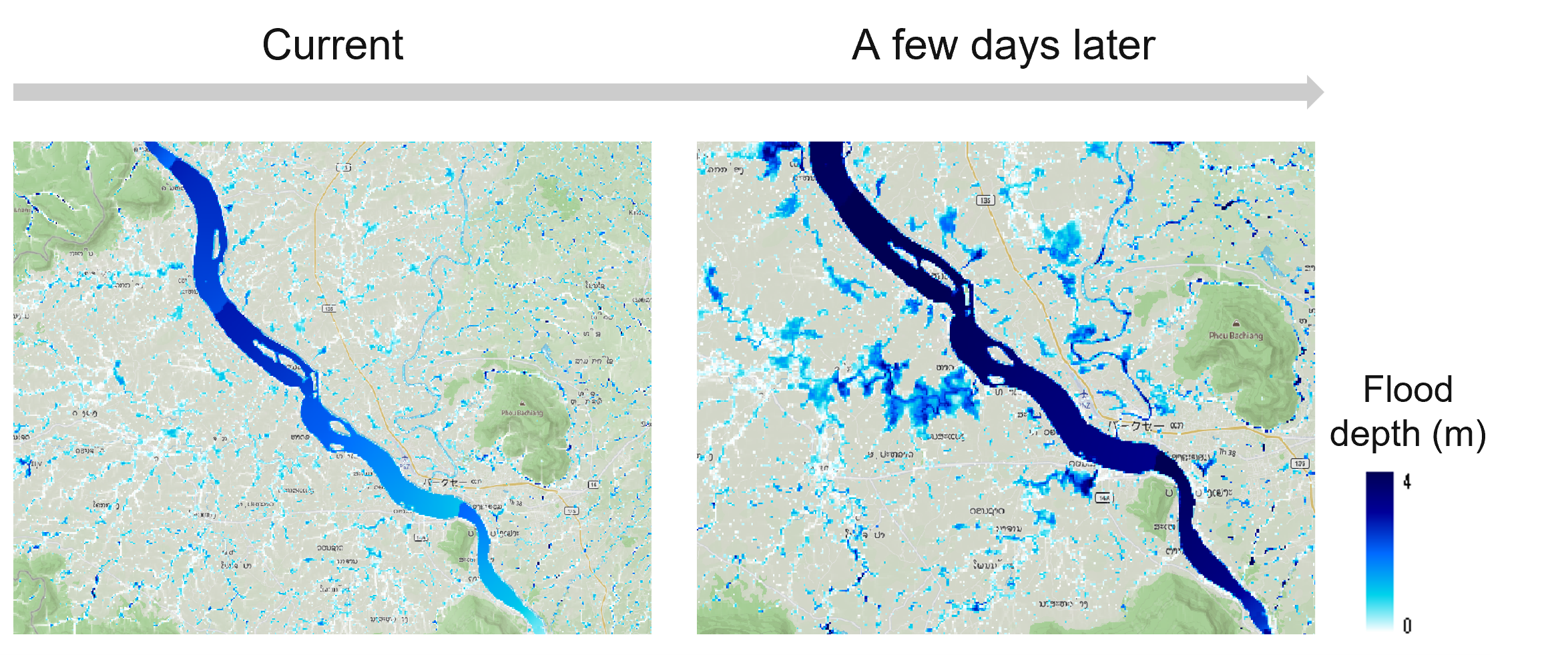
Aqunia is capable of providing not only river water levels but also concrete ‘inundation extent and depth’ predictions across the entire world. Through high-resolution simulation, inundation conditions can be forecast up to a few days before a disaster strikes — supporting well-considered evacuation decisions and accurate risk assessment.
5. Summary
Data underpins the effectiveness of ‘watershed flood control’
In the face of increasingly severe flood disasters, the key to making watershed flood control work lies in objective forecast data. No matter how meticulous an evacuation or investment plan, it cannot be effective if the underlying forecasts are inaccurate. Aqunia quantifies ‘how much a river will overflow’ with high precision through proven simulation technology and ensemble forecasting.
Through scientifically grounded flood and climate change prediction products, we support confident evacuation decisions and waste-free disaster prevention investment — contributing to the construction of a safe social infrastructure.
If you are interested in our solution, please do not hesitate to reach out to us.