



Aqunia Climate

Quantify The Climate Risks That Threaten Your Assets.

Entire countries and site-level physical risk assessment for floods, extreme rainfall, and droughts — from historical baselines to future scenarios. Built for disclosure, strategy, and investment decisions.
THE PROBLEM

Physical climate risks are material, yet most organizations cannot measure them.

Risks are invisible
Companies cannot quantify how floods, heavy rainfall, and droughts impact their sites and supply chains, leaving decisions based on intuition rather than evidence.
Disclosure demands evidence
ISSB/TCFD/TNFD responses and mandatory climate risk disclosures require numerical data. Organizations lack the internal capacity to produce credible, site-specific figures.
Public sector adaptation planning demands future-ready evidence
Governments and public agencies face growing pressure to assess long-term climate risks and develop science-based adaptation plans. Without quantitative projections of future risk conditions, infrastructure planning and policy decisions remain reactive rather than resilient.
WHY AQUNIA CLIMATE?

Most organizations know they need to act on climate risk. Few know where to start.

IPCC reports and disclosure frameworks point to urgency , but translating that into concrete analysis for your sites, your sector, and your decisions is a different challenge entirely.
 
Common pain points we hear
" We know climate risk is real, but we don't know which data or methods to trust.
" We have risk numbers — but can't connect them to investment decisions.
" We need disclosure-ready outputs, not just scientific reports.
Aqunia Climate addresses each of these
01
User-first approach
We start with your situation, not our technology.
Before any analysis, we map out the full landscape of options with you — which hazards matter for your region, which datasets are most appropriate, and what "actionable" means for your governance structure. The right approach varies significantly by sector, geography, and objective. We help you navigate that complexity rather than defaulting to a one-size-fits-all method.
CMIP6 ISIMIP3b CORDEX d4PDF NIES2020 Dataset selection guidance
02
Science-grade quantification
Site- and region-specific risk, grounded in world-class models.
Using hydrological models developed at the University of Tokyo (CaMa-Flood / ILS) and our proprietary localization technology, we calculate flood inundation, extreme rainfall, and drought risk at the scale that matters for your facilities. Validation and calibration against local observations — and satellite data where ground truth is sparse — ensures the numbers are credible, not just modeled.
CaMa-Flood / ILS GSMaP · SWOT Local calibration Local model
03
Decision-ready outputs
From climate science to the metrics that drive action.
Risk numbers alone rarely move decisions. We translate physical risk results into the indicators your organization actually uses — ROI of adaptation measures, investment prioritization across sites, cost-benefit analysis of countermeasures. The output is designed to be used in board discussions, disclosure filings, and capital allocation — not just filed in a report.
ROI analysis TCFD / TNFD / ISSB Investment prioritization
OUTPUT EXAMPLE

The full pipeline — from rainfall statistics to business decisions.

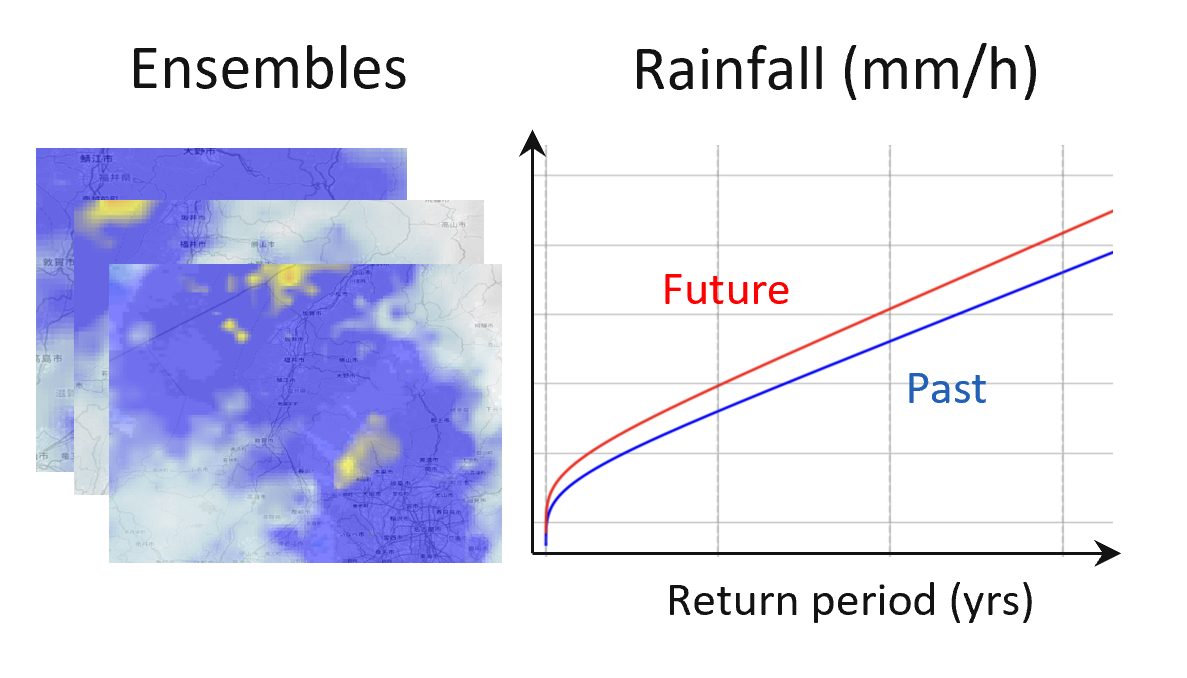
Step 1
Extreme rainfall analysis
Statistical analysis of historical and future extreme precipitation using ensemble outputs. Return-period curves for each climate scenario.
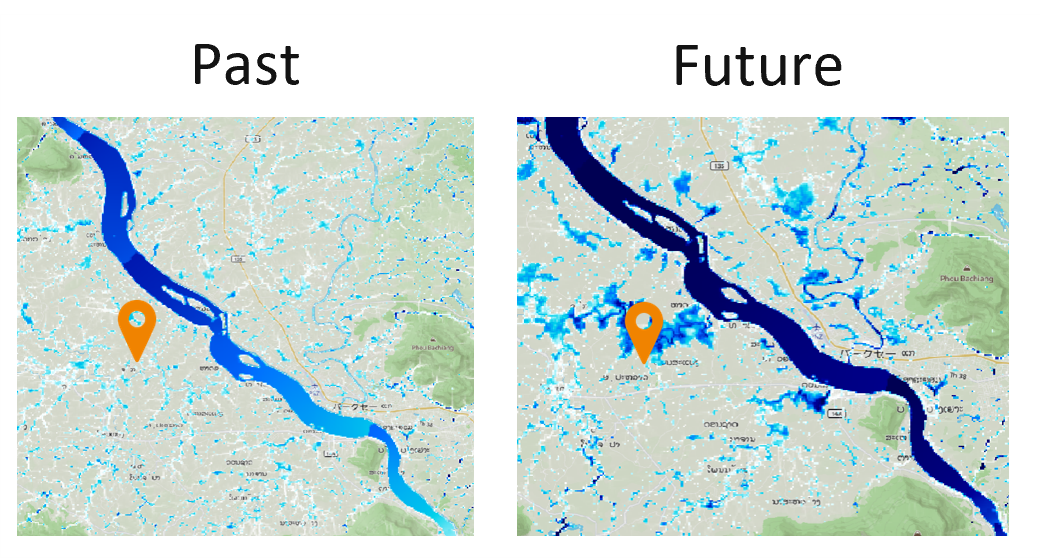
Step 2
Flood inundation risk
Site-specific inundation depth and extent maps for past and future climate — visualized at facility level.
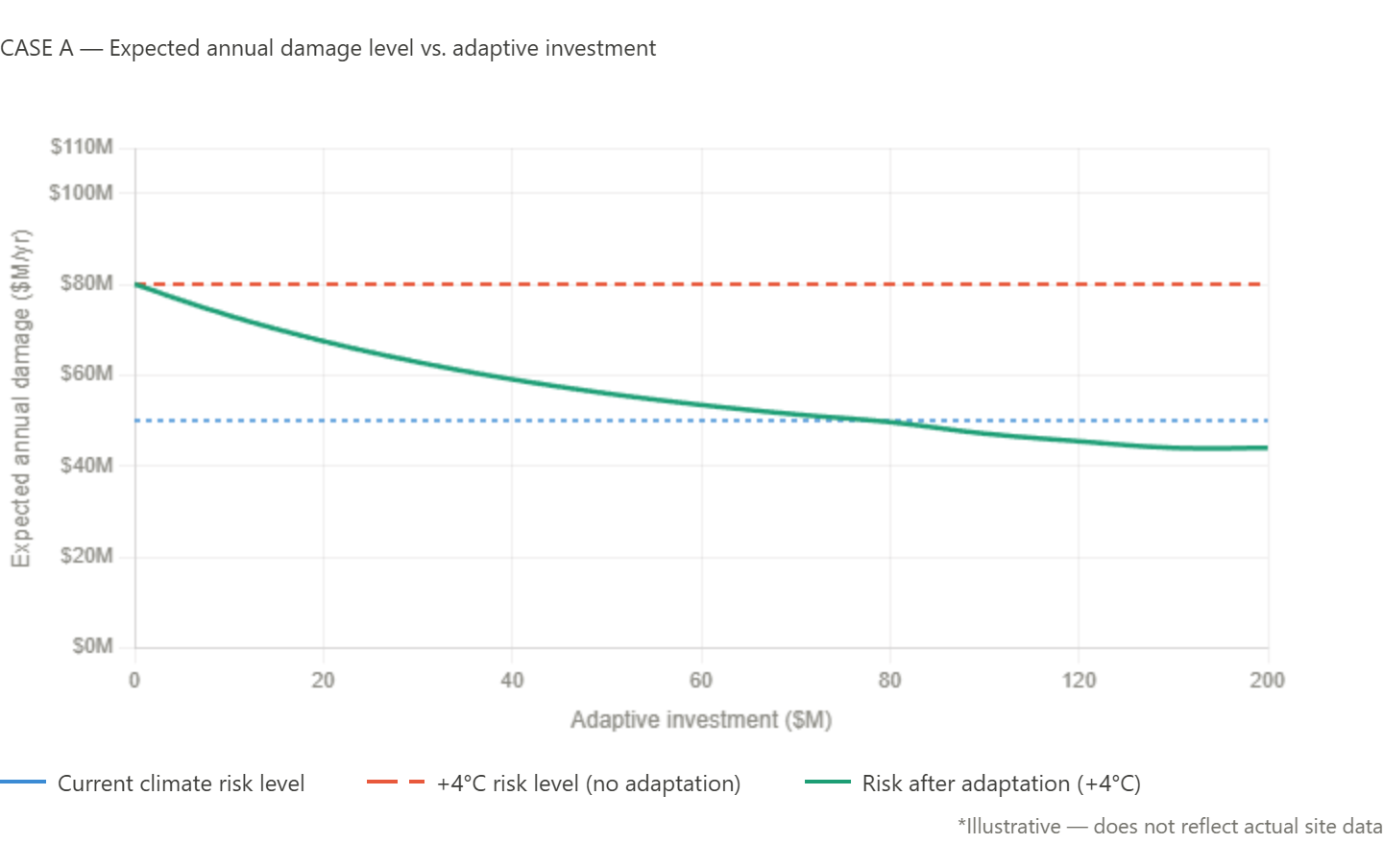
Step 3
Management decision outputs
Risk translated into investment prioritization curves and disclosure-ready reports aligned with your governance framework.
aqunia climate step1
aqunia climate step2
aqunia climate step3 mod
Example output using a manufacturing site scenario. Illustrative — does not reflect actual data.
For Organizations

Built for the organizations that need answers.

Any organization with physical assets exposed to climate risk.
 
Manufacturing / Infrastructure / Construction
  • ·Quantify flood and rainfall risk across domestic and overseas sites
  • ·Produce numerical evidence for TCFD/TNFD securities disclosure
  • ·Prioritize BCP enhancements and capital investment
Finance / Insurance / Real Estate
  • ·Evaluate physical climate risk of investment and lending targets at site level
  • ·Refine flood risk assessment for underwriting
  • ·Estimate risks via simulation in data-scarce overseas regions
Government / Public Sector
  • ·Quantitatively assess impacts on regional infrastructure and water resources
  • ·Develop science-based adaptation plans for future climate scenarios
  • ·Produce evidence for national or development agency reporting
Global / Overseas Companies
  • ·Conduct climate risk assessments aligned with ISSB global disclosure requirements
  • ·Apply advanced Japanese modeling technology to overseas site evaluation
GETTING STARTED

First, tell us about the risks your organization is facing.

The right approach depends on your analysis scope, target sites, and objectives. Engagements can start with a spot analysis.
1
Scoping
2
Pilot Analysis
3
Analysis & Reporting
4
Expand & Ongoing Monitoring
1
Scoping

Identify target sites, regions, and key stakeholders. Confirm industry context, disclosure objectives, data environment, and timeline. Define analysis scope and propose a cost estimate.

people, girls, women, students, friends, talking, meeting, study, group, activity, homework, group work, brainstorming, group study, people, people, people, students, students, students, friends, friends, friends, talking, meeting, meeting, meeting, meeting, meeting, study, study, group
2
Pilot Analysis

Conduct an initial risk analysis for a representative site or region. Validate the selected datasets and methodology, and confirm the approach for full-scale analysis.

Overhead view of financial charts, magnifying glass, and stationery on wooden table.
3
Analysis & Reporting

Quantitatively assess climate risks across all target sites/entire regions using ensemble climate simulations and hydrological modeling. Support deliverey of disclosure-ready reports or adaptation planning with recommendations on adaptation measures and investment prioritization.

African American woman working in office analyzing data on dual computer monitors.
4
Expand & Ongoing Monitoring

Extend coverage to additional sites, hazards, or scenarios as your program matures. Update analyses in response to evolving climate science, regulatory requirements, and new disclosure frameworks. We remain a long-term partner as your climate risk management program grows.

Hands pointing at a financial stock chart on a digital screen, highlighting data analysis and trends.

Share Your interest

The right approach varies significantly depending on your organization type, target regions, data environment, and project stage.
Even if you are unsure your interest is related to our solution, we encourage you to reach out to us.