




Quantitatively assess the risks climate change poses to your business and develop effective countermeasures.

Aqunia Climate is a service that quantitatively evaluates physical risks from climate change—such as floods, heavy rainfall, and droughts—at site and facility levels. Leveraging existing technological foundations while providing customized analysis results and reports, it supports decision-making in management, investment, and disclosure.

Aqunia Flood Aqunia Climate
Time Horizon
Real-time to a few days ahead
Past to future scenarios
Delivery Model
Product-based
Customized analysis & reporting
Use Case
Early warning systems / disaster response
Disclosure, strategy, investment decisions

Physical risks from climate change are increasingly recognized as urgent business challenges.

Risks are not “visible”

Companies cannot quantitatively grasp how floods, heavy rainfall, and droughts impact their sites and supply chains, leading to decisions based on intuition.

Unable to prioritize countermeasures

As TCFD/TNFD responses and mandatory climate risk disclosures in securities reports progress, organizations lack “numerical evidence” internally.

Unable to prioritize countermeasures

Even when risks are acknowledged, companies struggle to determine which sites to address first or where to invest.

Aqunia Climate combines climate ensemble simulations and hydrological modeling to calculate physical risks at each location numerically. Beyond data provision, it supports translation into financial impacts, adaptation strategy development, and disclosure responses in an integrated manner.

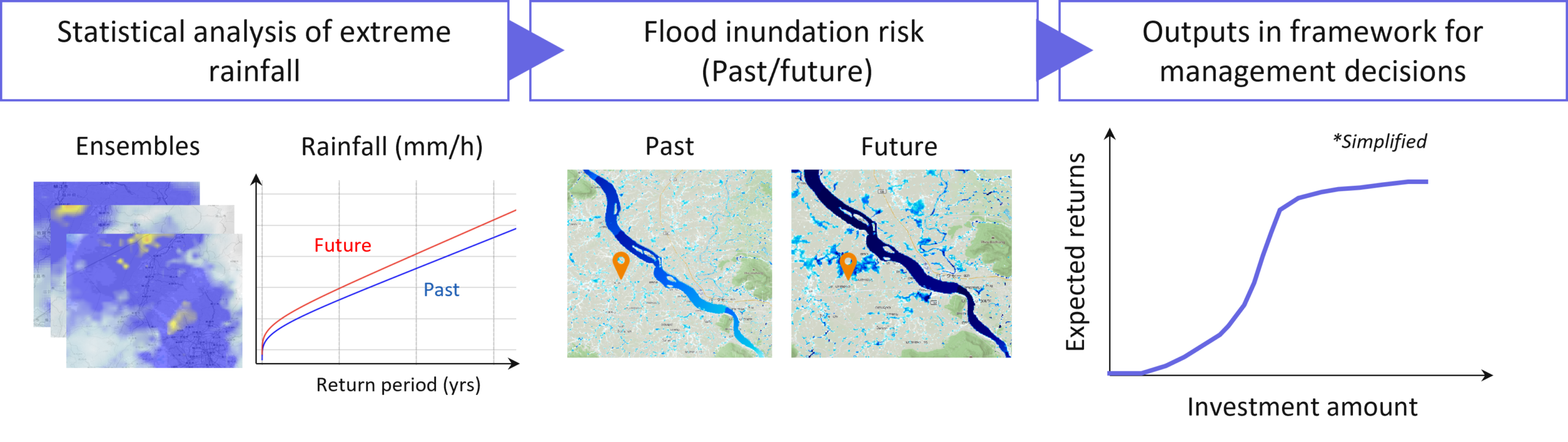
Output Example

conceptualimage aqunia climate

An example output illustrating the full process—from statistical analysis of extreme rainfall to flood risk assessment and integration into management decision frameworks—using a manufacturing site scenario.

For organizations facing these challenges

製造・インフラ・建設

政府・公共機関

金融・保険

多国籍企業

Built on world-class climate simulation technologies

Combining climate ensemble simulations (e.g., CMIP6 climate models) with hydrological modeling technologies developed at the University of Tokyo (CaMa-Flood / ILS), future risks are estimated while ensuring consistency with historical data. Even in data-scarce regions, accuracy is maintained using satellite data (e.g., GSMaP / SWOT).

Supported Analysis Types

組織が直面しているリスク/課題感を起点に段階的に分析・活用を進める

The optimal approach depends on the analysis scope, target sites, and objectives (disclosure, adaptation strategy, investment decisions). Engagements can start with a spot analysis. Initial consultations are free.

1

Hearing

Confirm target sites, industry, disclosure objectives, data environment, and timeline. Propose analysis scope and cost estimate.

G7fc5d2a3e1ba2aedaeab3bedd42e2864ec435214d375ef4bc9357f575aabec198736263dab1dc2ef0f4f1c24d0c349af 640 2557396
2

Analysis & Evaluation

Quantitatively calculate site-specific risks using climate simulation and hydrological modeling, with interim reporting.

Pexels Photo 6801636 6801636
3

Reporting & Advisory

Deliver reports aligned with disclosure frameworks and provide recommendations on prioritizing countermeasures and adaptation strategies.
Pexels Photo 7948099 7948099